Our pets play such an important role in our lives. They are often there for us when no one else is. They can be our best friend and companion or a connection to others with a shared experience. Pets rely on us and offer us unconditional love. Our daily routines are set around them. Our pets give us a reason to get out of bed in the morning and they often remind us of this if we are late to feed them. They remind us not to work too hard. I know that if I sit at my desk for too long, my dogs are sure to remind me to play ball or go for a walk. They make us laugh and sit with us when we cry.
All of this and much more can make saying goodbye excruciating. We understand that we are doing the best thing for our pet, by alleviating pain and suffering but it doesn’t really make it any easier on us. Our team understands this and so we have been dedicated to assisting you particularly during this difficult time. We have encouraged pet families to be as involved in the decisions surrounding end of life as possible. We encourage a ceremony that best suits everyone involved. Rituals and planning can aid in the healing process caused by the grief of loss.
During the COVID 19 Pandemic many of our families have noticed that these rituals have become more challenging. As with everything, there are new restrictions in place at veterinary hospitals to protect everyone’s safety. We all agree that these restrictions are reasonable and necessary but some families are struggling with them all the same. We recommend that each family contact their veterinarian to learn of their specific regulations to understand what will take place at their appointment time.
We want you to know that we are here to continue to support our pet community. Our appointments might look a little different but our goals for a peaceful farewell are still the same. We have been getting a lot of questions about what an end-of life appointment will look like at this time so we wanted to take a minute to let you know what changes you might see from us.
At the present time we are not entering homes so all meetings will be outside. We will discuss as much as possible with you on the phone prior to your appointment and will meet you outside when we arrive . A few people have been concerned about this but we can say that being outside surrounded by nature can have a calming effect on pets and their people, especially on a bright sunny day in the shade of a tree while the birds chirp above. We continue to offer you the time you need with your pet and encourage you to include any rituals, such as music or prayer that make sense to you.
We will visit you as a team of 2 so we ask that you do not have more than 8 family members present, allowing us to stay within public health guidelines. We also ask you to respect social distancing rules. We will come prepared with masks and gloves for ourselves, and we will ask you to step back a couple of times but otherwise we will stay distanced to ensure that you are with your pet as they slowly drift off to sleep. If at any point you need more time we are able to accommodate that, just let us know.
Although you can definitely follow us to the car we do ask that you allow us to carry your pet and place them into the comfy dog bed in our vehicle, to prevent cross contamination into or from the vehicle. We will continue to treat your pet as lovingly as if s/he was our own. The crematorium has on-line services so that you can choose any options you prefer from the comfort of your own home without outside contact. Of course, we are only a phone call away to assist with anything that you may need during this process.
Just as before the pandemic, in the time following any euthanasia will stay in touch to support you through your grief where needed. We know that this isn’t easy. We have been there ourselves and we want you to know that you are not alone, even when all of us are feeling the strain of social isolation.
In December 2019 the world learned of the Novel Coronavirus COVID-19 and since then it has spread across the globe. Although, at this time we are at a very minimal risk here in Canada, experts do think that it is only a matter of time before it becomes endemic here as well. People are starting to take precautions and planning for illness and quarantines. As a matter of fact it is impossible to find any hand sanitizer for sale in my small town as people stock up in the hopes of preventing infection.
But what about our pets? Can they contract this COVID-19? Can they spread it? Although this specific coronavirus is a new mutation, coronaviruses themselves have been around for quite some time. As a veterinarian I am concerned about different coronaviruses in different species but the fact is that each of these viruses is species specific. For example the feline coronavirus that results Feline Infectious Peritonitis is only found in cats and the canine coronavirus which results in diarrhea in dogs is only found in dogs. These viruses do not cause disease in any other species, unless the virus mutates. This is most likely the case with COVID-19 as well so it is unlikely to infect our pets.
What about the dog that tested positive in Hong Kong on February 27, 2020? To be fair, we don’t know what the true meaning of the test is at this point as investigations are ongoing, but at this point the dog in question has not shown any clinical symptoms of illness. It is being cared for under quarantine and is continuing to be monitored and tested. There is no evidence that pets can spread the COVID-19 virus, however it is always best to take precautionary measures during any illness.
Many of the precautions that we recommend include general precautions that should always be taken when handling pets and other animals.
Wash your hands thoroughly after handling animals
Wash pet bedding regularly
Bathe your pet if he/she has been around sick people or animals
If possible, it is recommended that an alternative healthy person care for a pet if the primary caregiver is ill.
If someone in your home is ill it may be a good idea to bathe your pet more frequently.
Don’t forget to include your pets in your emergency planning. We recommend that you keep a two weeks supply of food, medicine, kitty litter and other supplies on hand in the event that you become sick and can not get out to get these supplies for your pet.
If you have specific concerns about your pet and COVID-19 contact your veterinarian for the most current advice specific to your location.
If you follow veterinary medicine at all you are probably aware that February is dental month. A month where the veterinary profession focuses on educating pet owners about dental health in pets. As our pets are living longer and as we make changes to their body composition through breeding we see more and more dental disease. In fact, dental disease has become a very common health concern in most of our pets. Prevention is an important part of keeping our pets’ mouths healthy. The single most important thing is daily brushing, however even daily brushing doesn’t necessarily rid the teeth of all of the plaque and tartar that accumulates over time. Even though we brush our own teeth every day we still need to visit the dentist routinely to clean what the toothbrush and dental floss just don’t get. We are not able to provide dental care in your home but we do refer our patients to competent, professional veterinarians with a passion for excellent oral health.
So in honour of Pet Dental Health month this story is about a little dog with unexpected dental concerns.
Visible plaque and calculus on a dog’s teeth
Lela was a spunky 15 year old, little Chihuahua with a real zest for life. She was a little diva who loved playing with her toys and cuddling on the sofa with her humans. You would never guess her age just by looking at her. Her owner, Belinda was totally in love with Lela and doted on her to no end, being diligent in her care and wanting only the very best for her. As Lela entered her golden years she was relatively healthy until one day when she started sneezing.
Initially, the sneezing wasn’t very consistent. Lela would sneeze about once or twice a day maybe without any discharge so Belinda wasn’t really that concerned about it. “maybe she has a virus” Belinda thought. The sneezing didn’t get better, however and in fact Belinda was noticing that the sneezing was becoming more frequent and she wasn’t playing with her toys as much. Instead of once or twice a day Lela was sneezing multiple times daily, every day and sometimes multiple times in an hour. It was at this point that Belinda noted a drop of blood in the discharge that was now present when Lela sneezed. Belinda immediately called us to come take a look.
Lela was still in good spirits when we arrived but we did note that she wasn’t as active or playful as she had been the last time we had seen her. Dr. Henderson performed a full physical examination on Lela. She did sneeze during the exam and she was painful when her face or mouth were touched. Dr. Henderson examined Lela’s mouth and noted that her teeth looked to be clean but that some of them were loose and still others were missing. No masses or other abnormalities were noted in the mouth.
“Well, Belinda.” Dr. Henderson started, “I see that Lela is missing some teeth. When did this occur?”
“It was just recently,” Belinda answered. “Lela stopped eating for a day a few weeks ago. She lost one tooth and then another and then she started eating again, so I thought that she was fine.”
Dr. Henderson explained that Lela was missing more than 2 teeth and that this was an indication of severe dental disease and was likely the cause of the sneezing. Belinda was shocked! “But I have been taking her to get her teeth cleaned regularly. The groomer brushes her teeth every time that she goes there and when her breath starts to smell I take her to the person who cleans her teeth without anesthetic. I didn’t want to risk the anesthetic at her age. I really don’t think that it is dental disease that is causing the sneezing. What if it is something else? I am afraid that she could have a tumour in her sinuses.”
“I understand your concern for Lela. I know how important she is to you and just like you I want what is best for her.” Dr. Henderson explained. “How would feel about scheduling an x-ray of her sinuses to rule out other causes of the sneezing and we can go from there.” Belinda agreed that this was a good plan and x-rays were scheduled and taken of Lela’s sinuses.
Special dental x-rays are best to identify dental disease and can pick up subtle changes much better than sinus x-rays, however even without the specialized dental x-rays, Lela’s images were able to pick up severe dental disease in all of Lela’s remaining teeth. The disease was so bad that Lela’s jaw bones had started to disintegrate due to long term infection and inflammation. There wasn’t any sign of a mass or other cancer present.
How did this happen? Belinda was very careful about caring for Lela. She knew that taking care of her teeth was important and she had enlisted the help of people she trusted to help her in this endeavour. Did the dental disease really progress this quickly?
Dr. Henderson explained what likely happened. “Each tooth is like an iceberg, in that there is a visible portion in the mouth but there is an even larger portion under the gum-line which we can not see. This is the part that contains the root or roots. The roots are held to the jawbone with very strong ligaments and the gum tissue adheres to the whole thing to protect the bone and the roots. If there is a defect in the gums bacteria can find its way to the bone, the ligaments and the root and this can cause the kind of decay that we are seeing in Lela. The visible portion of the tooth may still appear healthy, even as the structures under the gums are breaking down.”
“But how could I have prevented this?” Belinda asks.
“The best prevention is early detection and complete cleaning of the mouth, including a small portion of each tooth that we can reach under the gum line. Anesthetic is required to do this for our pets. When veterinarians perform a dental COHAT (comprehensive oral health assessment and treatment) it includes more than just cleaning the surface of the tooth. Under anesthetic pets can be positioned appropriately to get good dental x-rays to look at each root and the bone surrounding them. In this way they can determine if there is any early disease processes occurring here. Once the x-rays are taken, a full examination of the mouth and throat is performed to look for any sign of disease process there. Every tooth is cleaned with professional dental tools including an ultrasonic scaler which is able to remove very fine particles of plaque and tartar. This tool takes special training to be able to operate safely. The teeth and gums are again examined by the veterinarian and without dental tartar in the way, the doctor is able to measure any pockets that may be present between the gums and the teeth. Deep pockets found between the teeth and gums are a sign of disease and must be treated. Any teeth that are found to be diseased are removed to prevent further disease in the jaw bone itself and to cure the pain that this causes. Finally a high speed polisher is used on the remaining teeth to smooth out any microscopic ridges that have been created due to the cleaning. Dental cleaning tools are metal and will result in small defects in the enamel of the tooth. If these are not polished away they remain as an irregular surface perfect for plaque to attach.”
To summarize a veterinary dental procedure under anesthetic includes the following:
Dental x-rays
A full mouth examination by the doctor
Measurements of gingival pockets
A comprehensive cleaning with specialized equipment including subgingival scaling
Assessment and treatment of oral disease
High speed polishing of each tooth
Belinda was still worried about anesthetics but we explained the advancements in anesthesia over the years and that the risk for Lela was very low. In fact, her risk for succumbing to her dental disease was much higher than her risk of anesthetic complications so Belinda took Lela to have a full dental COHAT and due to the severe disease that was present she had most of her teeth extracted. She took a few days to recover but it wasn’t long before she was feeling better than she had in a very long time. She started playing with her toys again, had more energy and a better appetite than she had for years.
Comfortable Recovery
I hadn’t realized how sick she really was until I saw how well she did after the dental. I thought that she was just getting old, but it appears that she really wasn’t feeling well due to the degree of pain and inflammation in her mouth. I am so glad that I took her for this procedure.”
~Belinda
We are so grateful to have been a part of Lela’s recovery and we encourage you to speak to your own veterinarian about dental health and its importance to your pet.
Have your pets made any Resolutions for the New Year? I think that Daisy’s is to get even more cuddles than last year, and Sprocket? Well, he hasn’t let me know but I’m hoping that it’s to eat less socks and other odd things.
It’s not unusual for resolutions to be about becoming healthier and we think that’s a great resolution for our pets as well. Obesity is a very real problem in our pets and so making a resolution to get them in shape can reap tons of benefits. Not to mention that it can double up to get us more active as well. Today’s blog is about just such a resolution that took place a couple of years ago.
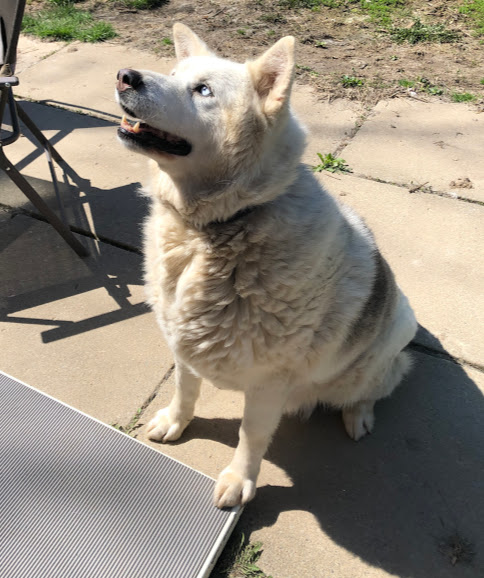
During a routine examination, we met a couple of beautiful female Huskeys, Winter and Bianca belonging to Mark. He loved his dogs so much and wanted the very best for them. They loved being outside more than anything so they spent a lot of time outdoors summer, winter, spring and fall. Mark was under the impression that because they spent so much time outside in the winter they should have a little bit of extra fat covering their bones. He didn’t skimp on their food and liked to keep them a little chubby. However, when we examined the girls, Mark was shocked to learn that they were more than a little chubby and that we were concerned about their health.
As in humans, excess fat can accumulate around organs contributing to a variety of health concerns, including:
Heart disease
Respiratory Disease
Difficulty exercising
Joint Disease
Skin Problems
Reduced ability to fight infections,
High Blood Pressure
Diabetes
Increased Risk during anesthesia
Even Decreased Life Expectancy by 2 years.
Mark was shocked! “Wow, I had no idea! Of course I don’t want any of those things for my girls. I want them to live long healthy, happy lives. I have noticed that they don’t like to go for walks as much as they used to, but I thought that was just because they are getting older. Do you think that it could be to the extra weight they are carrying? What can I do now?”
We discussed calorie restriction and foods formulated specifically to aid in healthy weight loss. We didn’t want them to lose the weight too quickly but it was important that they lose it. We created a nutrition plan specific to each dog which included their daily meals as well as the exact calories in treats they were allowed to eat. We didn’t want to deprive them of their special treats, just be cautious about how much they were eating.
“They are always hungry, though. How can I reduce their feeding size, they’ll starve?” We discussed that although they may eat all of their food, it may not necessarily mean that they are actually hungry. We also discussed how some prescription foods will help them to feel full with fewer calories.
“Another important aspect of weight loss is enrichment” we explained to Mark. “Sometimes pets will eat out of boredom or just because the food is available. We will help you to set up an enrichment plan for the girls so that meal and treat time is more exciting for them.”
We also developed an exercise program for the girls including specific exercises for home when the weather was too bad to make it for a walk and again to encourage enrichment in exercising, rather than the same thing every single day.
In looking at the whole dog we were able to create a program that included the nutritional needs, exercise needs and mental health needs of each.
Feeling lighter and more active
We can see a waist
As time went on, we were able to adapt our plans accordingly. Bianca was more stubborn and wasn’t interested in some of the exercises so we worked to find the ones that she did like and added and adapted those accordingly. Winter was more compliant and enjoyed all of the exercises. Mark was able to keep up with the plans we implemented and it wasn’t long before we were starting to notice a waist forming on each of them. Winter lost more quickly but with time Bianca caught up. After 2 years of sticking with their programs, both dogs have decreased their weight dramatically and are much healthier. They can not wait to go on their walks, are walking longer and are not begging for food at all. Mark was happy to announce that he feels fitter and healthier too with all of the walking he is doing with them. Win, win!
Mark does such a great job at taking care of his girls and we are so happy that we were able to contribute to this journey of health.
Has your pet ever had success with a resolution? We’d love to hear about it in the comments!
As the new year begins, I am caught contemplating what it will mean for us as we continue to serve you, our clients and patients. During the past decade my tiny one woman business has grown to a dedicated team which is very passionate about helping pets live their best lives right up until their final days. I am so lucky to be surrounded by this team on a daily basis, they are all amazing people who truly care about people and animals alike. All of us have all been working hard to improve our knowledge base and skills through continuing education courses and certifications in order to serve you better.
My goal has always been to assist you in providing the very best care for your pets. This year, I hope to be able to do that through an extension of our hours and services. We have added an additional evening for appointments and in the coming months we hope to have our new tele-health service up and running so that we can help you provide the care your pets deserve, even if we can not make it to you right away.
Personal and professional growth is very important to me. Without continual learning and an open-mind we can not reach our true potential. During recent years, I have been introduced to veterinary palliative medicine and it has become very important to me to assist clients and patients trough these final stages of their journey together. It is my belief that we have a long way to go in educating people about the benefits of palliative medicine, so as we move forward into the coming decade I resolve to look for as many opportunities to educate as I can. I will continue to write in this blog but I also welcome opportunities to speak on veterinary palliative medicine to pet lovers and veterinarians alike. Palliative care has made a huge difference in the lives of many of our clients and patients and my goal is to ensure that everyone who feels the need for this service knows that it exits.
I’d love to hear what resolutions you have made for the coming year or even decade. Do any of them involve animals? Please let us know in the comments.
Author: Dr. Janet Henderson, Palliative Care Veterinarian







 Palliative Tails